The forgetting curve
Hermann Ebbinghaus ran a long series of experiments on his own memory and published them in 1885 as Memory: A Contribution to Experimental Psychology. He learned lists of 13 nonsense syllables until he could recite them without error, then measured how much work it took to learn them again after a gap of 20 minutes to 31 days. The work he saved on relearning was his measure of what was left.
The loss was steep at first and slow later. One hour after learning, half of the original work had to be spent again. After 24 hours about a third was still remembered, after 6 days about a fourth, and after a month about a fifth. That shape, a fast drop that flattens out, is what people call the forgetting curve.
The spacing effect
In the next chapter Ebbinghaus compared crammed practice with practice spread over days. Repetitions spread over the three days before a test did as much as nearly twice as many made the day before. He concluded that "a suitable distribution of them over a space of time is decidedly more advantageous than the massing of them at a single time."
The finding has held up for well over a century. A 2006 meta-analysis by Cepeda and colleagues in Psychological Bulletin pulled together 839 assessments of spaced practice from 317 experiments in 184 articles, and found that the gap giving the best retention grew as the time you need to remember grew.
A 2008 study by the same group taught more than 1,350 people a set of facts, reviewed them after a gap of up to 3.5 months and tested them up to a year later. The best gap was about 20 to 40% of the test delay when the test came a week later, and about 5 to 10% when it came a year later. Put simply: the longer you want to keep something, the longer the gaps should get, which is why spaced schedules stretch.
Why recalling beats rereading
Spaced repetition is usually done as a test, and that matters as much as the spacing. In a 2006 study in Psychological Science, Roediger and Karpicke had students either reread prose passages or take recall tests on them. On a test 5 minutes later, rereading did better. Two days and a week later, the students who had been tested remembered substantially more, even though rereading had made the others more confident.
A 2013 review led by Dunlosky rated ten common study techniques. Practice testing and distributed practice were the two rated high utility. Summarization, highlighting and rereading were rated low. A summary helps you find an idea again; a question is what helps you keep it.
How review schedules work
Spaced schedules share two rules: a correct answer pushes the next review further out, and a miss brings it back soon. They differ in how they set the gaps.
- The Leitner box: paper cards in a row of compartments, proposed by the German science journalist Sebastian Leitner in 1972. A card you know moves to the next compartment, which you review less often; a card you miss goes back to the first.
- Fixed expanding schedules: the gap grows by a set factor each time you remember, and resets when you forget.
- Adaptive schedules: software estimates when you are likely to forget each item from your past answers and sets the next date from that estimate.
How scrollandlearn schedules reviews
scrollandlearn turns the posts you save into lessons, and the lessons feed Today's quiz. Every day it asks a few questions about lessons you saved, each written from the lesson. You answer in your head, tap Show answer, then grade yourself: Forgot, Kind of or Knew it. The grade sets when the lesson comes back.
Forgot
Tomorrow
and it starts over
Kind of
In 4 days
and it keeps its progress
Knew it
In 14 days
then 35, 88, 219 days, then a year
Forgot brings a lesson back tomorrow and starts it over, Kind of brings it back in 4 days, and Knew it in 14 days, then 35, 88 and 219 days, then a year. From 14 days to 219, each Knew it in a row stretches the gap about two and a half times, which follows the research above: longer gaps for what you already hold, a quick return for what slipped.
Quiz this topic runs the same quiz on a single topic, for when you want to go over one subject before you need it. The example below shows a lesson with the question the quiz asks about it.
Ask for the plan first
Ask for a plan and approve it before the model writes the full draft.
Key points
- Request an outline or approach first, then approve it before the full draft.
- Ask what it would need to know to do the task better before it starts.
- Use the plan as the record of what you actually asked for.
- On long tasks, re-show the plan partway through to stop drift.
Try this
On your next long task, ask for an outline first.
Remember this
Fixing a plan costs a sentence, fixing a draft costs a rewrite.
In the quiz
Why ask the model for a plan before the draft?
Filed under AI prompts
The knowledge score
Each topic shows a knowledge score: the share of lessons you remembered out of the lessons in that topic that have come up for a quiz. A lesson counts as remembered when your last grade was Knew it and it is not due again yet. It is a running answer to the question a schedule exists for, how much of this subject is still with you.
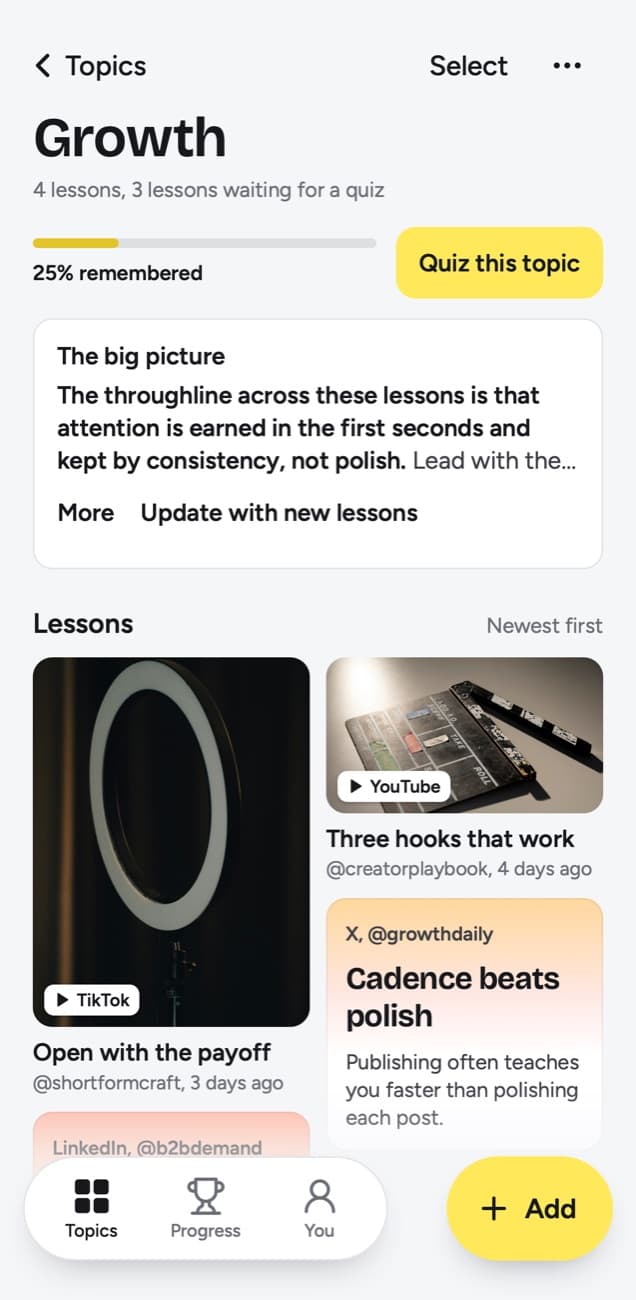
A lesson has come up once you grade it or once its quiz day arrives, answered or not. One that is waiting for an answer counts as not remembered, so a topic whose lessons came due without answers shows 0%. Before any lesson in a topic has come up, the topic has no score yet. A score that drops is a sign to run Quiz this topic.
Where it helps and where it does not
Spaced repetition is good at keeping facts, rules of thumb, definitions and one-line ideas. It does less for skills that need doing. You can remember that a steak should rest about as long as it cooked and still need to cook a few steaks to get it right. That is why a scrollandlearn lesson also carries Try this, one concrete thing to do, when the post suggests one, and Things to try keeps the ones you pick with a done check.
Frequently asked questions
- What is the difference between spaced repetition and the spacing effect?
- The spacing effect is the finding that practice spread over time is remembered longer than the same practice massed together. Spaced repetition is a method that uses it, with reviews scheduled at growing intervals.
- Do I need flashcards?
- No. Any question you answer from memory works. In scrollandlearn the question is written from the lesson for you, and you check your answer against the lesson.
- How long are the intervals in scrollandlearn?
- Forgot brings a lesson back tomorrow and starts it over, Kind of brings it back in 4 days, and Knew it in 14 days, then 35, 88 and 219 days, then a year.
- Is rereading my notes enough?
- It helps less than it feels. In the Dunlosky review, rereading and highlighting were rated low utility, while practice testing and distributed practice were rated high.


