Why a saved recipe rarely gets cooked
Recipe videos are made to be saved. A cook sears a steak in thirty seconds, the caption promises the best weeknight pasta, and the save button sits under your thumb. Months later the saved tab is a wall of two hundred thumbnails, and choosing one at six in the evening means opening them one at a time.
Most of those videos taught one thing you could use in any kitchen: why pasta water needs that much salt, how long meat should sit before you cut it. The dish was the example and the technique was the lesson, and a picture of a finished plate can't remind you of it.
What a recipe video turns into
A pasted Reel or TikTok where the cook speaks returns as a lesson, usually inside a minute, with a transcript of what was said; a YouTube cooking video does the same when it has captions. It reads in seconds: the technique named in one line, key points holding the steps and the reasons behind them, a Try this for your next attempt when the cook suggests one, a single marked Remember this, and the link to the post under the cook's handle.
Salt the pasta water
The cooking water is the only chance to season the pasta itself, so salt it well.
Key points
- Add the salt once the water boils, then wait for it to dissolve before the pasta goes in.
- Save a cup of the starchy water before draining, it binds the sauce.
- Finish the pasta in the pan with the sauce rather than pouring sauce on top.
- Undercook slightly in the water because it keeps cooking in the pan.
Try this
Taste the water next time you cook pasta. It should taste clearly salty.
Remember this
If you can't taste the salt in the water, it is not enough.
In the quiz
Why salt pasta water so heavily?
Filed under Cooking
Look at what the example keeps: why the water is salted, why a cup of it is saved, why the pasta finishes in the pan. Those reasons travel to dishes the post never showed. Another example, Rest the steak properly, shows what a TikTok cook's video might become: one line for the next piece of meat you cook, rest it as long as it was in the pan. That one has no Try this, as happens when a video suggests nothing to do.
Which cooking posts become a lesson
A lesson needs words the app can read: what the cook says in a video, or the text printed on the slides of a photo post. A video's caption does not count, however long it is. Those two rules decide what works and what doesn't.
| What you saved | What you get |
|---|---|
| A Reel, TikTok or Facebook video where the cook explains the method out loud | A lesson written from the transcript, usually the most complete kind |
| A YouTube cooking video or Short with captions | The same: a transcript from the captions, then the lesson |
| A video set to music with the whole recipe typed into the caption | No lesson about the recipe, however long the caption. The lesson is written from what is said, and a video's caption is not used |
| A carousel or TikTok photo post of recipe cards with the steps printed on the slides | A lesson from the printed text on the slides, once caption and slide text together reach about 300 characters |
| A video set to music with the steps shown as words over the food | No lesson. Words laid over a video are not read, and with nobody speaking, an upload of the file has no spoken steps either |
| A carousel of plated dishes with a short caption | No lesson. Photos of food are never described |
| A Pinterest pin that leads to a recipe blog | Only the pin's title and description, never the text on its image, and no lesson under 300 characters; the blog itself is not saved |
Unsure whether a video is worth pasting? Play a few seconds with the sound on. A cook who talks through the method gives the app all it needs, and a video set to music gives it nothing to write from. For a photo post, look for the method printed on the slides themselves.
Cooking fills in as its own topic
You don't have to make a recipe folder. Each lesson is filed into a topic named after what you keep saving, such as Cooking, and Change moves one elsewhere, including to a New topic you name yourself, say Baking. If your saves spread over several small topics, the app suggests grouping them, and you decide.
Each topic keeps a big picture, a short summary across its lessons that is rewritten as more arrive. With a dozen cooking lessons from a dozen cooks, it reads like the habits you picked up: season early, rest the meat, keep some pasta water back. Related lessons connect them: open the one on searing, and the one on resting can sit below it.
Getting techniques back before you need them
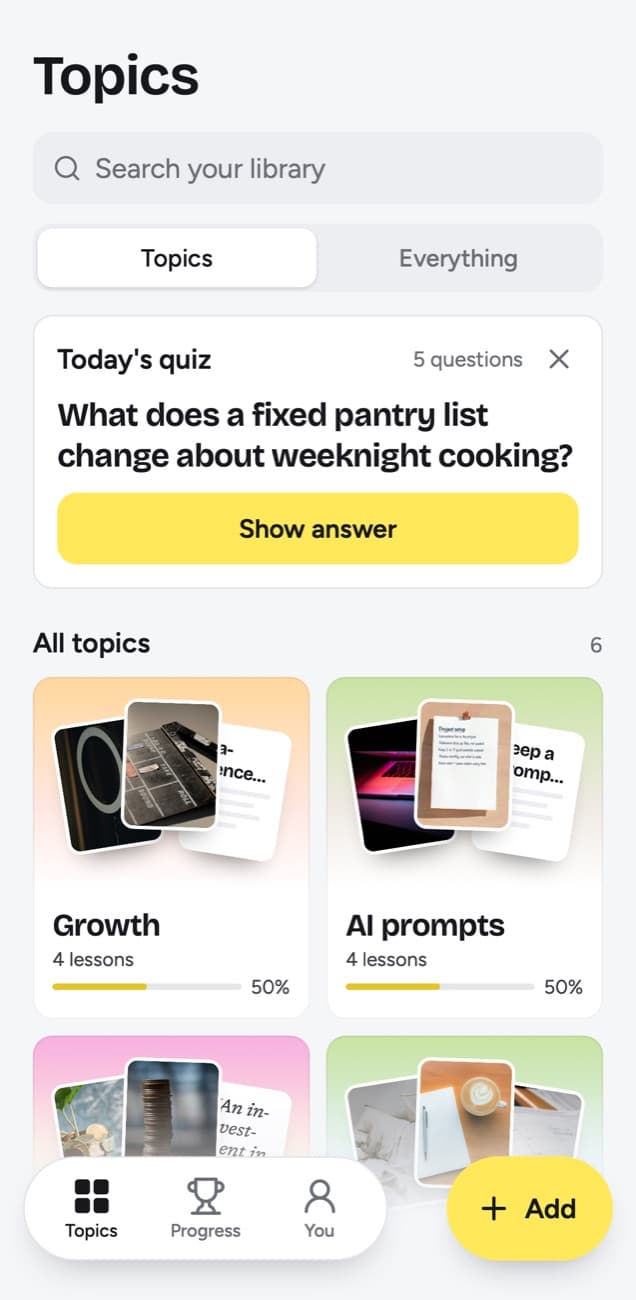
A technique helps only if it comes to mind at the stove. Today's quiz asks a few questions a day, each written from a lesson, like the one under the example: why salt pasta water so heavily? You answer in your head, tap Show answer and grade it Forgot, Kind of or Knew it.
Forgot brings it back tomorrow from the start, Kind of in 4 days, Knew it in 14, and after that the gaps grow to 35, 88 and 219 days, then a year. Before a big cook, Quiz this topic runs Cooking alone. Its knowledge score shows how many of the lessons that came up you remembered, and a lesson comes up on its quiz day whether you answer it or not, so weeks without the quiz can leave Cooking at 0%.
Things to try, and notes about your own kitchen
When a cook suggests something small to test, the lesson ends on it, like the example's Try this: taste the water next time you cook pasta. Add the ones you mean to do to Things to try, a list with a done check beside each.
My takeaway is where you write, in up to 500 characters, what the cook could not know: your oven runs hot, your pan is thin, the kids want less spice. Search covers takeaways, titles, key points, the core idea, Try this, Remember this, topics and handles, and the exact words of transcripts, so an ingredient the cook mentions in passing can still bring the lesson up.
What it reads from cooking posts
| You paste | You get |
|---|---|
| A TikTok, Reel, Facebook video, Snapchat Spotlight or Twitch clip where someone talks | A transcript of what is said, a short summary and key points |
| A TikTok, Reel or Facebook video with music and no talking | Usually no lesson: it is written from what is said, and the caption is not used |
| A YouTube video or Short with captions | A transcript from the captions, a short summary and key points |
| A YouTube video or Short without captions | No lesson; it asks you to upload the video file |
| A YouTube community post | Its text and the text printed on its images; together they need about 300 characters |
| A post on X, Threads, Reddit, Bluesky, LinkedIn or a public Telegram channel | The text of the post you link, written down as a lesson; replies and comments are not read |
| A video on X, Threads, LinkedIn or Reddit | Under 300 characters of post text: a transcript of what is said (on Reddit, from its own captions), or else the post's text. 300 or more: the post's text, without the video |
| A photo post or carousel on Instagram, TikTok, X, Threads, LinkedIn or Telegram | The text printed on the images; photos are not described. On Instagram and TikTok, caption and slides together need about 300 characters |
| A Spotify or Apple Podcasts episode | The whole episode, transcribed from the show's public podcast feed; a Spotify exclusive gives only its title and description |
| A private or deleted post | No lesson; it can't be read, so upload the file if you have it |
| A link to an article or any other website | Not saved; only posts from the 15+ supported platforms, and LinkedIn articles |
- Cooks who narrate on Reels, TikTok or Facebook give the fullest lessons, because the reasons come out when someone talks. On YouTube the lesson comes from the video's captions, so a cooking video without them gives none.
- Instagram carousels and TikTok photo posts are read slide by slide for printed text, so a recipe card with the method on it works; a photo of the plated dish adds nothing.
- On Reddit, a post's title and written text are read, so a post in a cooking community that spells out a method works. Its photos and replies are not read.
- A deleted or private post can't be read. If you kept the video file, Upload the video takes up to 50 MB, which helps when the cook talks; a clip with only music has no spoken steps.
What it is not: a recipe manager
scrollandlearn keeps how you learned to cook, and none of the bookkeeping a recipe app does:
- No ingredient list as structured data, so nothing to tick off in the shop.
- No meal planning and no shopping list.
- No scaling of servings or unit conversion.
- No connection to a recipe app or Notion; Export lessons downloads your lessons as Markdown, CSV or JSON.
- No typed or handwritten family recipes. It saves links to public posts from the 15+ supported platforms, and recipe blogs are not among them.
For the dishes you cook weekly, with their amounts and lists, a recipe manager is the right home. Keep scrollandlearn for what carries from one dish to the next: the technique, the reason and the mistake to avoid.
Frequently asked questions
- Will it save the full ingredient list from a recipe Reel?
- No. There is no ingredient list field. The key points hold the method and the reasons, and the link leads back to the post for the exact amounts.
- Does a recipe video with no talking work?
- No, not for the recipe. A video's lesson is written from what is said in it, and the caption is not used for a video, so a recipe typed under a music-only Reel or TikTok gives no lesson however long it is. Words shown over the video are not read either. If the cook also posted the recipe as a carousel or a TikTok photo post with the steps printed on the slides, paste that instead.
- Can it read a recipe card in a carousel?
- Yes, the printed text on each slide of an Instagram carousel or a TikTok photo post, up to 20 slides, counted with the caption toward about 300 characters. Photos of food are never described, so picture-only slides with a short caption give no lesson.
- Can I save recipes from Pinterest or food blogs?
- A pin gives its title and description, never the text on its image, and under 300 characters no lesson. A link to a recipe blog or any other website is not saved; a pasted link works only for posts from the 15+ supported platforms.
- Can my family cook from the same library?
- No. The library is private and nobody sees it but you. There is no shared space for a household; Share as image sends one lesson as a picture.
- How many recipe posts can I save a month?
- Starter covers 100 saves a month, Creator 250 and Power 1,000. 10 lessons free, no card.


